Essay No. 06
Part 5: How Much Control Do We Have Over Our Economic Trajectory?
Think about where you are economically right now.
Listen instead
17:20 · Narrated with an AI voice
Think about where you are economically right now. Not financially. Economically.
Your job. Your income. Your education. Your savings. Your debt. Your transportation. Your family obligations. The skills you have. The people you know. The house you own or the apartment you rent.
How much of it did you actually cause, or choose?
Maybe you worked incredibly hard to get where you are. Maybe you saved while other people spent. Developed skills. Took risks. Changed jobs. Started a business. Went back to school.
Those choices matter.
But you didn’t choose your parents or family. Or the economy you were born into. Or many of your earliest opportunities. You probably didn’t create the people who opened doors for you, the recession that closed one, the technology that made your career possible, or the accident of being in the right place at the right time.
Those things matter too.
Now try explaining your economic life without using either of these two ideas:
What happened to me.
What I did about it.
I’m not sure we can.
The last essay in this series asked who participates in prosperity. I ended up thinking about practical freedom, the difference between technically having a choice and possessing enough margin for that choice to become realistically available.
But that was mostly a snapshot in time.
What choices are available to me from where I currently stand?
Life doesn’t stay still long enough for the snapshot to last. By the time we have thought about the present, it’s in the past. The choices I make today can change where I stand tomorrow. And where I stand tomorrow changes the choices available to me after that.
How much influence do we actually have over our own economic trajectory?
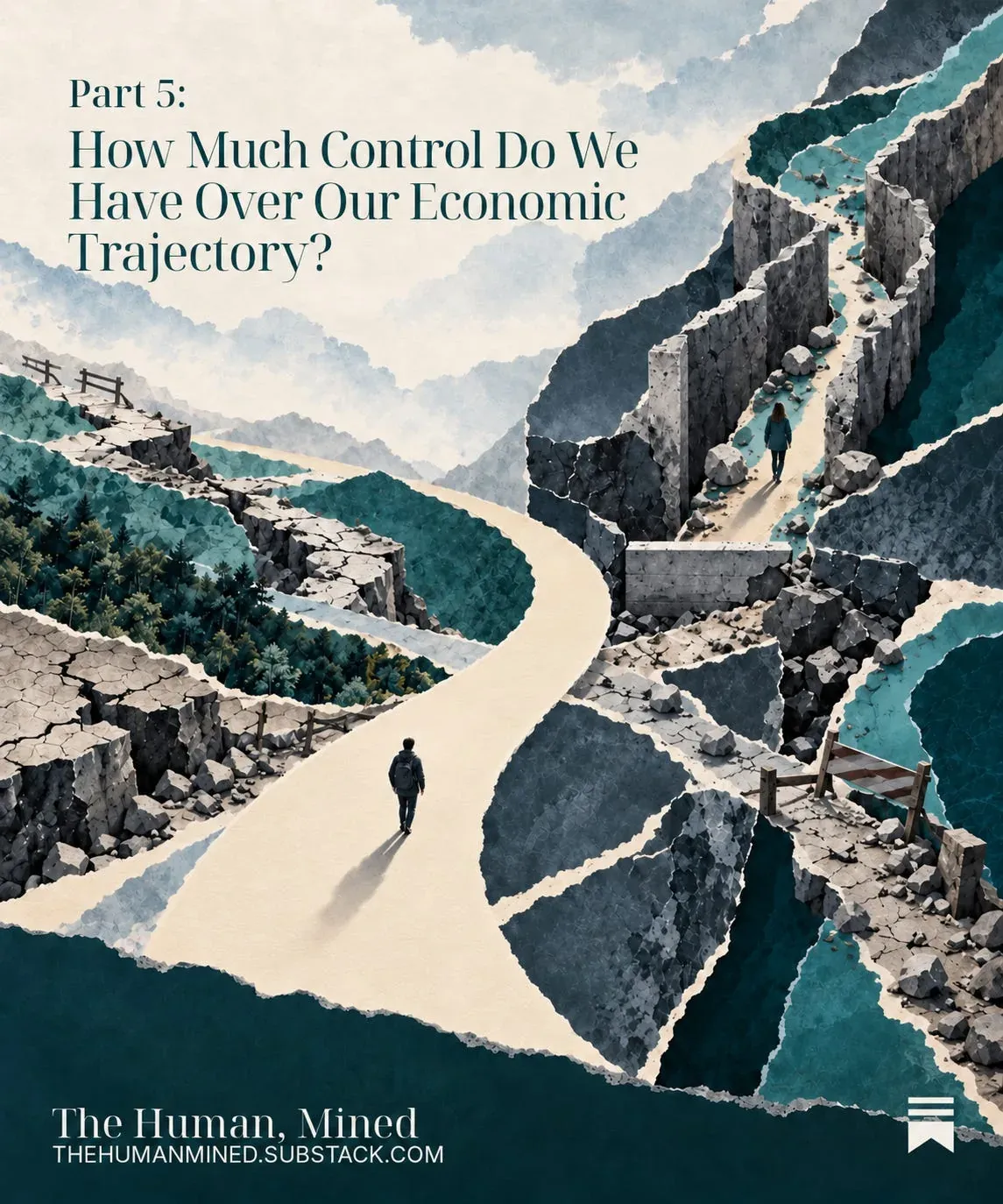
I keep using the word trajectory because it captures something the snapshot misses.
Bear with me for a moment. In physics, position tells us where something currently is. It doesn’t tell us where it’s going. For that, we need to know something about its direction, momentum, and the forces acting on it.
The problem is that people aren’t inanimate objects moving through space. We perceive what is happening. We make judgments. We have values. We learn. We deliberately respond and make course corrections.
But maybe that makes the analogy even more useful.
Two people can occupy roughly the same economic position while moving in very different directions. They might earn the same income today. One is accumulating skills, savings, relationships, and options. The other may be running out of options.
Same current position. Very different trajectory.
And trajectories can build on themselves.
Learning a skill can increase what my labor is worth. Higher earnings can make saving more plausible. Savings can create enough margin to change jobs or invest. A job change can create new skills and relationships. Those can create opportunities I couldn’t have seen from where I started.
The process can run the other way too. Debt can reduce margin. Losing a job can consume savings. Reduced savings can make taking another risk harder. A bad investment can lose money. A bad decision today can narrow tomorrow’s choices.
Today’s consequences become part of tomorrow’s circumstances.
That starts to look a little like momentum. Skills can create additional opportunities. Capital can generate more capital. A professional relationship can lead to another relationship. Experience can make the next opportunity easier to recognize.
Disadvantage can accumulate too. One setback can consume the margin needed to absorb the next one. Company downsizing. A storm. An illness. An accident.
But economic lives aren’t governed by Newton’s laws. People change direction. They learn. They recover. Markets change. Unexpected opportunities present themselves. Outside events intervene.
And sometimes the thing changing the trajectory is the person.
Maybe that’s where economic agency begins.
Not total control over the outcome.
The ability to intentionally influence what happens next.
If saving, developing skills, working hard, taking calculated risks, building relationships, or creating something other people value can improve my future possibilities, that seems like agency functioning exactly as I would hope.
Unequal trajectories can result from meaningful differences in what people chose to do. That matters. Choices that affect what becomes possible later give agency economic significance.
If nothing I deliberately do can alter my future possibilities, how much economic agency do I really have?
Is that practical freedom?
But influence doesn’t operate under identical conditions.
Imagine two people who want to change careers. One has savings, transferable skills, few financial obligations, and several professional relationships in the new field. The other has no savings, significant debt, family obligations, and no relationships in the industry.
Both can make the choice. Both may succeed. And both may fail.
But the same decision carries very different levels of difficulty and risk.
That doesn’t tell us whether the difference is unfair. Some of it may result from previous choices. Savings may have taken years to build. Skills may have been deliberately developed. Professional relationships may reflect decades of good work. Some obstacles contain useful information too. A lender should care whether someone is likely to repay a loan. An employer may reasonably care whether an applicant has the necessary skills and can reliably do the job.
Not every obstacle is evidence that something is wrong.
But not every obstacle was created by the person encountering it either.
And there’s another complication. Human beings don’t merely encounter circumstances. We interpret them.
I went to college partly because that was what someone in my circumstances was supposed to do. I grew up in a family where education mattered. My parents were educated, had high expectations, and held us accountable. I went to a college prep high school. Many of my friends and all of my siblings graduated from college, and some went beyond.
I didn’t.
Construction interested me much more.
Nobody forced me to study psychology in college, and nobody prevented me from leaving. Those were my decisions. But the expectations around me definitely affected which path initially seemed normal.
That makes me wonder about someone who grows up where very few people attend college, start businesses, invest, or work in certain professions. Those paths are still available.
But how easy is it to imagine yourself taking a path you’ve rarely seen anyone around you take?
Maybe the people and examples around us don’t determine what we can do. But they can affect what we know about, what seems realistic, and how much uncertainty we attach to something unfamiliar.
We can reject the expectations around us. We can discover possibilities we weren’t shown.
But first we have to see another path.
How much is our view obscured?
I think it can be.
And that idea makes me uncomfortable.
Because taken far enough, circumstances can explain away almost anything. Some people allow that to become their life story.
If my upbringing shaped my expectations, circumstances shaped my opportunities, culture shaped my values, markets shaped my incentives, and luck shaped some of my outcomes, eventually I can construct a story in which I never actually achieved anything.
I don’t believe that either.
People make choices. They work. Save. Spend. Learn. Take risks. Waste opportunities. Create opportunities. Make mistakes. Recover from them.
And those choices can become part of what later looks like circumstance.
Savings may exist because someone spent years living below their means. Skills may reflect thousands of hours of deliberate practice. Professional relationships may come from decades of reliability. Capital may exist because someone took a risk that could have failed.
Sometimes what looks like momentum was built. Sometimes what looks like friction was too.
Circumstances constrain agency without eliminating it. Agency changes circumstances without controlling them.
I don’t know how to separate those cleanly. Maybe trying to separate them is part of the problem.
We routinely look at economic outcomes and construct causal stories backward.
A successful entrepreneur took a smart risk.
Did she?
Or did she take a questionable risk that happened to work?
Another entrepreneur failed.
Was the decision irresponsible?
Maybe.
Or maybe it was a thoughtful risk that encountered something nobody could reasonably have predicted.
The person making the decision didn’t get to make it backward. They had to make it forward. Without knowing the outcome.
How much can an outcome really tell us about the choices that produced it?
Not nothing.
Repeatedly making reckless decisions and blaming predictable consequences on bad luck eventually becomes ridiculous. But success doesn’t prove wisdom any more than failure automatically proves irresponsibility.
That makes me suspicious of how confidently we explain other people’s economic lives.
When someone succeeds, what do I notice first?
Their discipline?
Their advantages?
When someone struggles, what do I notice?
Their decisions?
Their circumstances?
Maybe the more revealing question is whether I use the same explanations for myself.
Do I explain my own success by what I did, but someone else’s success by what was handed to them?
Or the reverse?
Do I explain my own failures by circumstances, but someone else’s failures by their irresponsible choices?
Those questions bother me more than deciding whether agency or circumstances matter more. I’m not sure there is a useful universal answer. Even within one life, the balance changes.
Skills, savings, information, relationships, experience, and opportunity can increase our ability to influence what happens next. Debt, obligations, shocks, and previous mistakes can reduce it.
Trajectories can change.
But greater agency doesn’t necessarily mean greater wealth. That would take me backward in this exploration.
Someone might build enough economic capacity to leave a higher-paying career and spend more time raising children. Someone else might use it to start another company. Another might care for a parent, travel, serve a community, retire early, or keep working because they love what they do.
The destination is still theirs. And it should be. Agency matters because it may give them greater influence over getting there.
So, what exactly should we infer when we look at where somebody ended up?
Maybe less than we usually do.
An outcome tells us where they are. It may even tell us how far they moved.
It doesn’t tell us every circumstance that acted on them, which advantages they built themselves, which obstacles they created, which ones they encountered, which opportunities they recognized, which ones they never saw, or what they reasonably could have known when they made the decisions that helped put them there.
That doesn’t require abandoning personal responsibility. Responsibility means choices matter. It doesn’t mean choices are the only things that matter.
And acknowledging circumstances doesn’t require believing people are powerless. It means asking how much influence they actually had from where they stood.
Maybe that is the question I should have been asking all along.
Not:
Who deserves where they ended up?
Not:
Who is responsible?
But:
How much capacity did they have to influence where they went next?
And then the analogy starts to change.
Because eventually the things affecting my trajectory aren’t just circumstances, markets, luck, or my own choices. They can include you. And I can become part of what affects yours.
I’ve experienced that from both directions. People have hired me, taught me, trusted me, invested in me, and opened opportunities I couldn’t have created entirely on my own.
Over time, I’ve had opportunities to do some of those things for other people. I’ve hired people. Taught skills. Mentored. Been a sounding board. Invested in businesses. Provided capital. Helped create opportunities that didn’t exist before.
Someone else’s economic capacity can expand mine. Mine can expand someone else’s. Sometimes both happen at once.
An employee can help a business grow while the business creates new opportunities for the employee. An investor can make an idea possible while the person with the idea creates value for the investor. Economic agency can be reciprocal.
That seems like one of its most powerful features. My ability to influence my own trajectory doesn’t necessarily come at the expense of yours. Sometimes we can change each other’s trajectories in ways that expand the possibilities available to both of us.
But influence can presumably run in more than one direction.
The same accumulated capacity that allows me to expand someone else’s possibilities may also give me the ability to narrow them.
And as that capacity grows, so might my ability to affect choices that aren’t mine. At that point, the question changes. I’m no longer asking only how much influence I have over my trajectory. I’m asking how much influence I have over yours.
When does economic agency become economic power?
Questions to sit with
- How much of it did you actually cause, or choose?
- How much influence do we actually have over our own economic trajectory?
- When does economic agency become economic power?
There are no right answers here. Just honest ones.
Where do you land?
Steelman the other side
The best case against this essay
The essay questions the common view that a person's economic outcome is a reasonably good guide to the choices and effort behind it.
- Outcomes may be noisy in a single case, but across many decisions and many years they tend to track behavior. Habits like saving, showing up, and learning skills show up reliably in results, so treating outcomes as informative is a sensible default, not a lazy shortcut.
- Stressing how circumstances shape what people can see or attempt risks weakening the belief that effort pays off. People who think their path is largely set may try less, and that belief can make their circumstances worse.
- Capacity to influence one's future is very hard to measure from outside. A standard built on it could invite endless second-guessing of other people's lives, while judging by choices and results is at least observable and consistent.
- Economic relationships are mostly voluntary exchanges. Competition, the option to walk away, and the law limit how far one person's capacity can narrow another's choices, so worrying about agency turning into power may overstate the risk in ordinary economic life.
Know someone who'd argue with this? Send it to them.