Essay No. 03
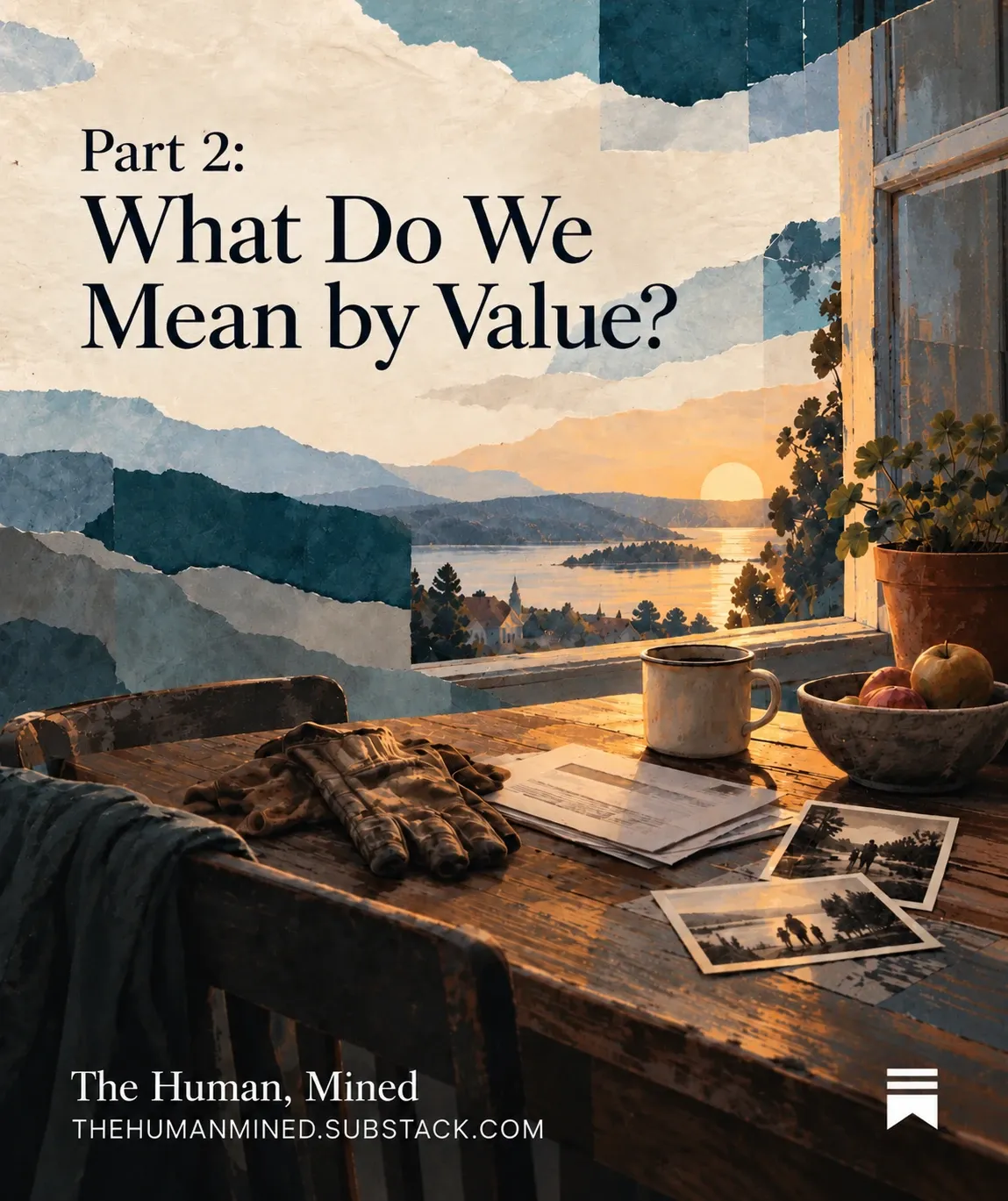
Part 2: What Do We Mean by Value?
In the first essay in this series, I kept coming back to a very important, yet seemingly simple concept that I never really devoted the time to define:
Listen instead
18:24 · Narrated with an AI voice
In the first essay in this series, I kept coming back to a very important, yet seemingly simple concept that I never really devoted the time to define:
I wrote about people creating value. Businesses creating value. Markets rewarding value. Economies becoming more productive by creating more value. It all sounds pretty straightforward.
But what exactly do I mean when I use the word value?
I used to work professionally as a woodworker, and I still build furniture, guitars, custom built-ins, and plenty of other things. Sometimes I do it because it’s cheaper than buying. Sometimes because I can make exactly what I want or need. Sometimes I just enjoy the process of designing and building things.
If I build a table for a customer and they pay me $2,000, it’s pretty easy to talk as though I created $2,000 worth of value. There was a transaction. There is a number attached to it.
More precisely, I know the table sold for $2,000. The buyer decided the table was worth giving up that much money for, and I decided the table was worth giving up for that amount of money.
But even that isn’t quite the same thing as saying we somehow measured exactly how much value was created.
What if I build exactly the same table for my own family?
Did I create less value simply because nobody paid me?
The table I build for my own home still exists. It still serves a very similar purpose to the one I sold. It may have saved me money. It may be exactly suited to what I need.
So maybe money and value aren’t quite the same thing. That sounds obvious when I say it that way. But I’m not sure we always behave as though it is.
Money is an extraordinary tool.
It gives us a common language for transactions that otherwise would be almost impossible to coordinate. I don’t have to find a farmer who needs replacement windows before I can buy vegetables from him. I can sell something to one person and use the money to buy a completely unrelated product or service from someone else.
I can earn money today and use it years from now. I can save it, invest it, give it away, or spend it down the road on something that hasn’t even been invented yet. And money gives us a remarkably useful way to measure and compare many things.
A house costs $400,000. Someone makes $25 an hour. A business earns $20 million.
Those numbers are concrete.
But does the usefulness of that measurement sometimes cause us to confuse what is simply easy to measure with what is valuable?
Suppose I have the option to work five extra hours and earn another $200. Or I can spend those five hours with one of my kids.
One side of that decision has a wonderfully precise number.
$200.
The other doesn’t.
We might say:
“She gave up $200 to spend the afternoon with her son.”
That’s perfectly accurate.
But so is:
“She gave up an afternoon with her son to earn another $200.”
Same tradeoff. Different framing.
I’m certainly not suggesting we should calculate the dollar value of an afternoon with our children. That seems to really miss the point. I’m asking whether the fact that one side can be measured precisely makes it easier for us to treat it as more real.
I’ve experienced another version of this myself.
One of my sons enjoys learning to build things and has spent a lot of time working on projects with me. If my only goal is finishing each task to complete the job as quickly as possible, having him there can actually make me far less productive.
Teaching takes time and patience. I stop, explain something, show him how to do it, let him try, and sometimes we need to fix a mistake. Sometimes we use more material.
Measured strictly by output per hour, I could probably accomplish more by myself.
So, was that afternoon working together less productive?
Maybe.
Was it less valuable?
I’m not sure those are the same question.
We built something, but he was also learning. We were talking. We spent time having fun together doing something we both enjoy. I was getting to teach my son something I care about. We also continued to build our relationship, and perhaps his confidence.
Maybe productivity measures something useful and specific, and the problem comes when we ask it to tell us more about value than it actually can.
None of this is to suggest that economists somehow haven’t thought about these distinctions. Economics has ways of thinking about opportunity cost, constrained choices, unpaid work, leisure, and plenty of other things that don’t fit neatly into a paycheck or a market transaction. You’d be hard-pressed to discover something that impacts the economy that economists haven’t studied. I haven’t discovered something novel here.
I’m more interested in something simpler: whether the rest of us remember those distinctions when we talk about what something is worth, how productive someone was, or whether another person made the “right” economic choice.
The more I think about value, the harder it becomes to separate it from the person doing the valuing.
And I’m beginning to suspect that part of my confusion comes from using the same word for several related but different ideas. The price of something, what it is worth to one particular person, what it contributes to someone’s life, and whether it creates benefits or costs for other people aren’t necessarily identical questions.
My three kids are a pretty simple example.
One enjoys woodworking.
Another has almost no interest in it. He spent much of his childhood playing highly competitive baseball instead. For roughly ten years, our family spent an enormous amount of time and money on practices, games, tournaments, gas, meals, hotels, equipment, and everything else that came with it.
Eventually, he stopped playing baseball. He didn’t earn a scholarship or go pro.
Did those ten years somehow lose their value because baseball didn’t become his career?
My daughter found something completely different. She loved being outdoors and spent many summers at camp. Eventually, she worked there, making substantially less money than she probably could have earned somewhere else.
Were those summers less valuable because she didn’t maximize what she could earn?
They’re all adults now, and they’ve gone in very different directions. Their careers are different. Their interests are different. The ways they choose to spend their time are different.
I could probably construct a nice story about how woodworking shaped one of them, baseball taught another discipline and competitiveness, or those summers at camp helped my daughter become the adult she is today.
Maybe some of that is true. But I don’t really know. Literally thousands of experiences, relationships, successes, failures, and decisions helped make each of them who they are.
Do those experiences have to eventually produce higher income, a career, a scholarship, or some other measurable return to justify the time and money spent on them?
Or can part of their value simply be that they were meaningful parts of three very different people becoming adults?
But there’s another part of this that truly matters.
My wife and I have been fortunate enough financially to give our kids many of those opportunities. And these are just a few examples.
Competitive travel baseball isn’t cheap. Neither is summer camp. Home projects require tools, materials, space, and time.
And those advantages didn’t end when our kids became adults. All three graduated from college with degrees and no student loan debt.
That doesn’t guarantee them success, and it doesn’t diminish the hard work each did to earn partial academic scholarships and their degrees. But it gave them more freedom and choice when they entered adulthood.
A lower-paying job that offers an opportunity they value may become more realistic. Moving somewhere new may now be possible. Saving for a house, changing careers, going back to school, or simply figuring out what comes next looks different when a large student loan payment isn’t looming every month.
Someone else may value exactly the same things my family does and not have the same ability to act on them. A parent working a second job may value an afternoon with a child every bit as much as I do and still need that $200 more than I do.
So, when one person chooses time and another chooses money, are we necessarily acting on different values?
Or do we sometimes simply have different amounts of freedom to act on the same values?
The choice tells us something.
But maybe it doesn’t tell us everything about what someone would have preferred if the available choices had been different.
And what happens if those differences persist long enough?
If generation after generation of people has a narrower range of practical choices, can that eventually influence what those people come to expect, pursue, or even believe is realistically available to them?
And if it can, does that eventually affect what they come to value?
Perhaps. I don’t know.
But if it does, the relationship between economic freedom and individual preference becomes considerably more complicated.
It also makes me hesitant to tell anyone else what they should value.
Someone may want to build a business. Someone else may want a job that they can leave at 5 p.m. every day. One person may value financial security above almost everything else because they grew up without it. Another may willingly give up some of it for more control over their time and flexibility.
I don’t think I get to rank or decide those choices for anyone but myself. And I don’t think we should mistake what our economy rewards financially for a judgment about what people ought to value.
That brings me back to something from the first essay.
I argued there that a prosperous economy should expand people’s capacity to make meaningful free choices about how they work within it and live their own lives. Maybe that’s one reason money matters so much. Because of what it offers.
You may remember, I’ve started thinking about money as a vehicle.
Having more financial resources gives that vehicle more capacity. It can give someone the ability to leave a bad job, start a business, absorb an emergency, help a child, retire, go back to school, or simply stop worrying about whether the bills will get paid every month.
Those are very meaningful forms of freedom. But the vehicle still doesn’t choose the destination. More money gives me greater capacity to pursue what I value, but it doesn’t tell me what I should value.
So, if money often functions as the vehicle, why do we so often talk as though accumulating more of it must be the destination for everyone?
We use financial measurements as a kind of scoreboard all the time. Income. Net worth. Revenue. Market value. Return on investment. GDP. The stock market.
All useful measurements.
But would we put someone’s ending bank balance on their tombstone?
“Here Lies John Doe. Loyal Husband. Loving Father. $3.2 million net worth at death.”
Obviously that’s absurd.
Not because money doesn’t matter. It matters enormously while we’re alive. It’s absurd because much of money’s value comes from what it allows us to do. It gives us capacity. It doesn’t tell us what we should do with it.
There is a problem, though, with simply saying everyone should decide value for themselves.
What if what I value harms someone else?
If something benefits me by taking away someone else’s ability to live their own life freely, I can’t simply declare it valuable and end the discussion. My freedom to pursue what I value cannot give me unlimited authority to eliminate someone else’s comparable freedom to do the same.
That doesn’t tell us exactly where the boundary belongs. Questions about regulation, wages, pollution, taxation, monopoly, inequality, and political influence get much harder very quickly. I intend to come back to many of them in detail later in this series. For now, it seems enough for me to recognize that individual preference can’t settle every question about value by itself.
There is one more part of the vehicle analogy that I think is useful. If we’re going to tell people they’re free to choose their own destination, they need some meaningful and realistic way to get there.
They need roads.
Different financial capacities aren’t necessarily unjust. Different destinations certainly aren’t. Even substantial differences in wealth don’t automatically mean someone’s freedom has been violated.
But what happens when people don’t have meaningful access to the roads at all?
I don’t yet know what counts as a road, how much access is enough, how smooth, wide and safe it needs to be, or who should be responsible for building and maintaining it.
Or what happens when someone’s economic power becomes sufficient to influence the roads everyone else’s freedom of travel depends upon?
Those are questions for later.
I started this essay asking what we mean when we say something creates value.
I’m not sure I have a definition.
Money matters. Productivity matters. Profit matters. Economic output matters. Markets give us enormously useful information about what people are willing to exchange. But none of these seems capable of answering the entire question.
Maybe that’s because there isn’t one universal destination.
If money is the vehicle rather than the destination, perhaps we need to ask more than how much money our economy creates.
What does that money allow free people to do?
How much freedom do they actually have to choose where they’re going?
And how much should we infer about what people value from choices they may not have been entirely free to make?
I still don’t know exactly what we mean by “value.” Maybe part of the problem is that I’ve been asking one word to do several different jobs. A price can tell us what someone was willing to exchange. Productivity can tell us something important about output. A choice can tell us something about preference. Money can tell us something about capacity.
All of those things matter. But they aren’t necessarily telling us the same thing.
I’d be willing to bet that most of us don’t walk around thinking in economic models. We say something was valuable, someone created value, a worker was productive, a purchase was worth it, or someone made a bad financial decision.
Maybe I’m simply becoming less comfortable pretending all of those statements mean the same thing to everyone.
What I am increasingly convinced of is that just knowing the price, cost, or financial impact of something doesn’t answer the entire question.
Ideas in this essay
Questions to sit with
- Did I create less value simply because nobody paid me?
- So, when one person chooses time and another chooses money, are we necessarily acting on different values?
- So, if money often functions as the vehicle, why do we so often talk as though accumulating more of it must be the destination for everyone?
There are no right answers here. Just honest ones.
Where do you land?
Steelman the other side
The best case against this essay
The essay questions the habit of treating money, prices, and productivity as adequate measures of value.
- Prices are not just convenient numbers. They pull together the judgments of millions of people about tradeoffs. Once value is separated from what people will actually give up, it can become vague, and almost anything can be called valuable without any test.
- Constrained choices still reveal values. Everyone chooses within limits, wealthy people included. Treating a lower-income person’s choice of money over time as possibly unfree can come across as paternalistic, as if outsiders understand that person’s real preferences better than they do.
- For many people, building wealth is a reasonable destination and not a confusion. The essay itself shows that financial resources gave the writer’s children debt-free degrees and real freedom. Putting earning and saving first can be an act of care for the next generation.
- Money is used as a common measure because nothing else allows comparison across people. Meaning, relationships, and fulfillment cannot be added up or weighed fairly in policy. The open question about “roads” also invites broad intervention, which has its own costs to freedom.
Know someone who'd argue with this? Send it to them.