Essay No. 05
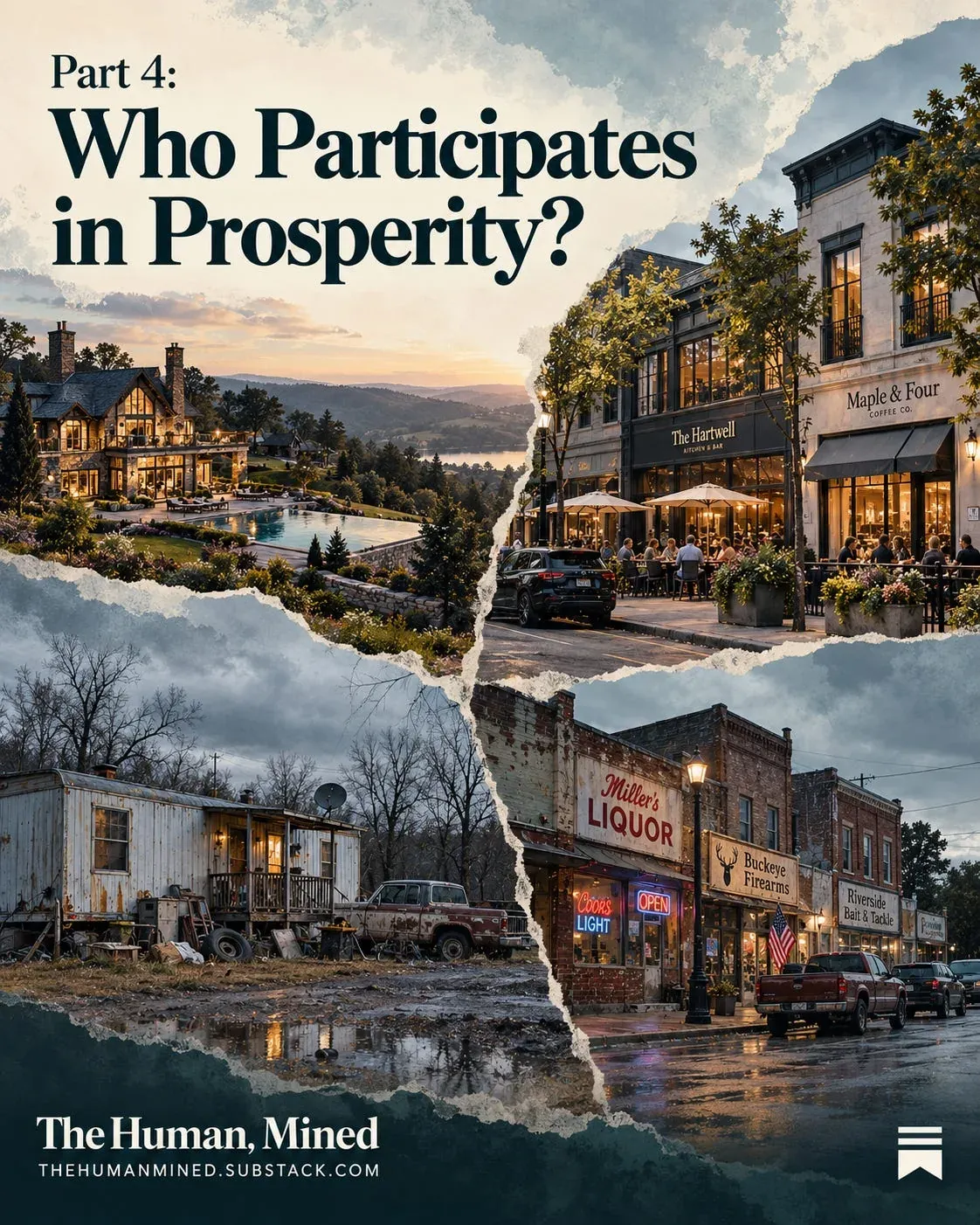
Part 4: Who Participates in Prosperity?
Imagine two baseball players trying to score.
Listen instead
16:54 · Narrated with an AI voice
Imagine two baseball players trying to score.
One is standing on third base with nobody out. The other steps into the batter’s box with two strikes and two outs.
The first player can score on a sacrifice fly. A ground ball. A wild pitch. A passed ball. Maybe someone drives him in without him doing anything else at all, and he can just casually trot home, keeping his uniform clean and avoiding a possible collision at home plate.
The second player can score too. He can hit a dramatic home run. Or he can patiently work the count, draw a walk, or get hit by a pitch as he crowds the plate. Then he steals second and advances on a wild pitch. He’s on third! But the weakest batter in the order is at the plate. His best chance might be to steal home.
Both players are allowed to play. Both are operating under exactly the same rules. Neither is guaranteed to score.
But I don’t think anyone watching the game would say they have the same opportunity to reach home plate.
We don’t even have to rely entirely on intuition. Modern baseball analytics can estimate run expectancy from remarkably specific game situations. We can estimate pretty well how much the players’ current positions matter in almost any situation.
But knowing their positions and the probabilities attached to them doesn’t tell me how they got there.
Maybe the first player on third hit a triple. Suppose he earned every inch of his advantage. Maybe he spent years practicing while the other player didn’t. He took countless batting practice swings, worked with coaches, stayed in shape, studied pitchers, and hit a frozen rope for the triple that put him there.
That matters. I don’t want an economic philosophy that looks at someone standing on third base and simply assumes his advantage must be unfair.
Now, change the story.
Suppose one player grew up with access to great coaching, good facilities, parents who could drive him to practice, money for travel baseball, and plenty of free time in the offseason to develop.
Suppose the other didn’t.
Same positions. Same statistical probabilities. Very different stories about how they got on the team, let alone third base.
So, what would I actually need to know before I could say both players had a genuine opportunity? To play? To score? To win?
These questions seem particularly important after the journey the first three essays in this series have taken us. I started by asking what an economy is actually for. Then, what we mean by value. Most recently, I asked what economic progress actually means.
That last question led me somewhere I didn’t initially expect. Maybe part of economic progress is becoming increasingly effective at producing what people value while freeing resources, including our time, from things we no longer need them to do.
But that leaves another question.
How does that additional capacity actually change what individual people are able to do?
At first I thought this essay might be about where productivity gains go. But there isn’t necessarily a pile of those gains sitting somewhere waiting to be divided among the masses. Greater productivity can show up through higher wages, lower prices, profits, investment, better products, more training, new businesses, and opportunities that didn’t exist before.
So maybe I need to ask something more basic.
What would convince me that a specific person actually participated in prosperity?
Income obviously matters. But if technology becomes dramatically better and cheaper, I might gain capabilities without earning another dollar. If something I need becomes less expensive, the same income can provide more. Savings, ownership, eliminating debt, or greater financial security can also change the choices available to me.
Maybe participation in prosperity isn’t ultimately about receiving some particular amount of money. Maybe it has something to do with what economic progress allows me to do.
That brings me back to freedom.
I value economic freedom. It’s one of the reasons I value markets, private ownership, entrepreneurship, and the ability of people to make their own economic decisions.
But what exactly do I mean by it?
Suppose I hate my job. Nobody is legally forcing me to stay there. I’m free to quit. I can go back to school. Change careers. Move somewhere with better opportunities. Start a business. Retire.
Those freedoms are real. I don’t want to diminish them simply because exercising them might be difficult.
But imagine I have almost no savings. I’m supporting a family. My health insurance comes through my employer. Rent is due in two weeks, and I can’t afford to miss a paycheck.
How free am I to quit?
I don’t think the answer is: not at all. My employer doesn’t own me. The government isn’t prohibiting me from leaving. People really do make enormously difficult choices from circumstances like these every day.
Now give someone else the same job and salary, along with a year’s expenses in savings, no debt, skills that are in high demand, and three other employers trying to hire them.
Both are equally free to quit in the legal sense.
Are they equally free in an economic sense?
I have a hard time saying yes.
The second person has something the first doesn’t:
Margin.
They can better afford for a decision not to work.
Money can create that margin, but it isn’t the only thing that does. Skills can. Experience can. Time can. Family support can. Education can. Having other opportunities can.
Maybe margin is simply the practical room within which our choices can actually operate. It can make changing careers, going back to school, relocating, starting a business, or accepting a lower-paying opportunity that feels more rewarding actually realistic.
Maybe part of economic freedom isn’t simply being allowed to choose.
Maybe it’s being able to survive being wrong about your choice.
I’m hardly the first person to stumble into this distinction. Much smarter thinkers, like Amartya Sen and others working in what became known as the capability approach, have spent decades examining the difference between possessing resources or formal rights and having substantive opportunities to act on those rights.
I’m not trying to take credit for or adopt that entire framework, much less use it to decide what level of opportunity society owes anyone. But the distinction itself seems important. Being allowed to make a choice and being in a position where that choice is realistically available aren’t necessarily the same thing.
And this creates another problem.
Where did that margin come from?
Maybe the person with savings spent fifteen years living below their means while the other spent everything they earned. Maybe the marketable skills came from years of night school. Maybe those competing job offers resulted from doing excellent work and building a strong reputation.
Those choices should matter. An economy in which discipline, saving, education, effort, good judgment, and calculated risk can expand someone’s future choices sounds like a feature to me, not a bug.
But not every difference begins with a choice made by the person experiencing it.
All three of my kids were fortunate enough to graduate from college without debt. They still had to choose careers, find jobs, work hard, make good decisions, and live with their mistakes. My wife and I couldn’t give them success.
But we could give them some margin.
Someone else might graduate with exactly the same degree, work every bit as hard, and begin adulthood with a substantial loan obligation. That doesn’t tell me which person will ultimately succeed.
It does seem tough to argue that they begin with the same range of realistic choices.
And that tension doesn’t disappear if we look further backward. People make real choices with real consequences. But they make them with abilities, families, communities, cultures, markets, institutions, opportunities, and circumstances they didn’t completely choose.
Following that reasoning too far creates the opposite problem. If every choice can be traced backward to some previous circumstance, eventually nobody is responsible for anything.
I don’t believe that either.
People possess agency. They work, save, spend, take risks, develop skills, waste opportunities, create opportunities, make mistakes, and live with consequences. Scarcity is real too. Some constraints are consequences of exercising freedom, not evidence that freedom was denied.
And two people given similar opportunities still won’t have the same probability of success. We differ in intelligence, ability, judgment, discipline, persistence, ambition, interests, willingness to take risks, and plenty of other ways.
I’m one of eight siblings, raised by the same parents, who held us accountable, valued education, and set boundaries.
Do I have the same practical freedom as my siblings?
I do not.
Practical economic freedom can’t mean eliminating those differences. It can’t mean an expectation of success.
So what does it mean?
Maybe somewhere between having a possible path and having a realistic one.
Not a guaranteed path. Not an easy one. A path where my choices, effort, abilities, judgment, and willingness to take risks have some meaningful chance of affecting what happens next.
Even that makes me uncomfortable.
What counts as meaningful?
I don’t know. And that word could hide almost any political view or conclusion someone wanted to put inside it.
Recognizing differences in practical economic freedom also doesn’t tell me that every difference is unjust, or that society owes everyone enough resources to make every option realistically available. Those are different questions.
I’m trying to understand something more basic first.
Is the economy one of the things I value about freedom?
Or is freedom one of the things I value about our economy?
What exactly am I claiming people are free to do?
Maybe prosperity doesn’t just expand what we can consume. Maybe it can expand what we can realistically choose.
The ability to survive losing a job. To say no to a job offer. To take the time to learn something new. To take a risk that might fail without that failure eliminating every other choice. To choose time instead of another dollar.
None of those guarantees a good decision. They give our decisions more room to matter.
And those decisions don’t all point in the same economic direction. We often talk about opportunity as though success means moving up some economic ladder. Higher income. More wealth. A better-paying career. A bigger house.
Those may be exactly what someone wants.
But someone else might use greater economic freedom to work less. Take a lower-paying job they find more meaningful. Leave a successful career. Move somewhere cheaper. Consume less. Trade income for time.
If people are supposed to choose their own destinations, I can’t define participation in prosperity by whether they moved in the direction I would have chosen for them.
Upward mobility assumes a direction.
Practical economic freedom doesn’t.
That also keeps me from treating inequality and participation as the same question.
Suppose everyone’s practical economic possibilities improve dramatically while a smaller group’s improve much more. Inequality increased.
Did prosperity decrease?
I don’t think that follows.
But now reverse the problem. Suppose an economy becomes dramatically more productive. Technology improves. Businesses grow. New wealth is created. But the realistic choices available to a substantial number of people barely change.
Who participated in the prosperity?
Now I’m back at the baseball field.
The stats can tell us how likely the players are to score based on where they are on the field. They can’t tell us whether the batter wasted opportunities the other player took full advantage of. Whether one began with advantages the other didn’t. Whether those advantages came from previous effort, someone else’s sacrifice, circumstance, luck, or some combination of all of them.
And even knowing all of that wouldn’t tell us who deserves to score.
That isn’t the question.
An economy doesn’t owe everyone the same position on the field. It doesn’t owe everyone the same outcome.
But if freedom is one of the reasons I value the game we are playing, I’m no longer satisfied knowing only that everyone had a chance to pick up a bat.
How broadly does an economy have to expand people’s practical freedom before I would consider the economy itself prosperous?
I don’t know.
Maybe answering that eventually takes me into inequality. Ownership. Government. Economic power. Political power. Those questions are coming.
But I don’t think I can get there responsibly until I understand what I mean when I say someone had an opportunity in the first place.
The scoreboard can tell me where the players are standing. It can tell me something about their chances of scoring.
But it can’t tell me how much room each of them actually had for their choices to change what happened next.
And maybe that brings me closer to the question I’ve actually been trying to ask:
When prosperity expands, how many people gain enough margin for their choices to meaningfully affect where they can go next?
Questions to sit with
- What would convince me that a specific person actually participated in prosperity?
- Are they equally free in an economic sense?
- When prosperity expands, how many people gain enough margin for their choices to meaningfully affect where they can go next?
There are no right answers here. Just honest ones.
Where do you land?
Steelman the other side
The best case against this essay
The essay questions whether equal legal freedom and the same rules for everyone are enough to say people share in prosperity.
- Formal freedom is clear and can be checked: either a person is prohibited from acting or not. Margin and practical freedom are matters of degree, and the essay itself admits that the word meaningful could hide almost any political conclusion. A standard that cannot be pinned down may be a poor guide for judging an economy.
- Much margin is built through choices like saving, training, and building a reputation. If an economy is judged by how much margin people have, the pressure to supply margin from outside may weaken the incentives that produce it, leaving fewer people with real room to choose over time.
- Advantages passed through families, such as a debt-free degree, are themselves an exercise of the parents' economic freedom. Treating them mainly as unequal starting positions risks devaluing the sacrifice and planning that the essay elsewhere says should matter.
- Markets have historically widened practical options for very large numbers of people through cheaper goods, new jobs, and new technology, often without anyone aiming at that outcome. Protecting open rules may do more for broad margin over time than measuring and managing it directly.
Know someone who'd argue with this? Send it to them.