Essay No. 04
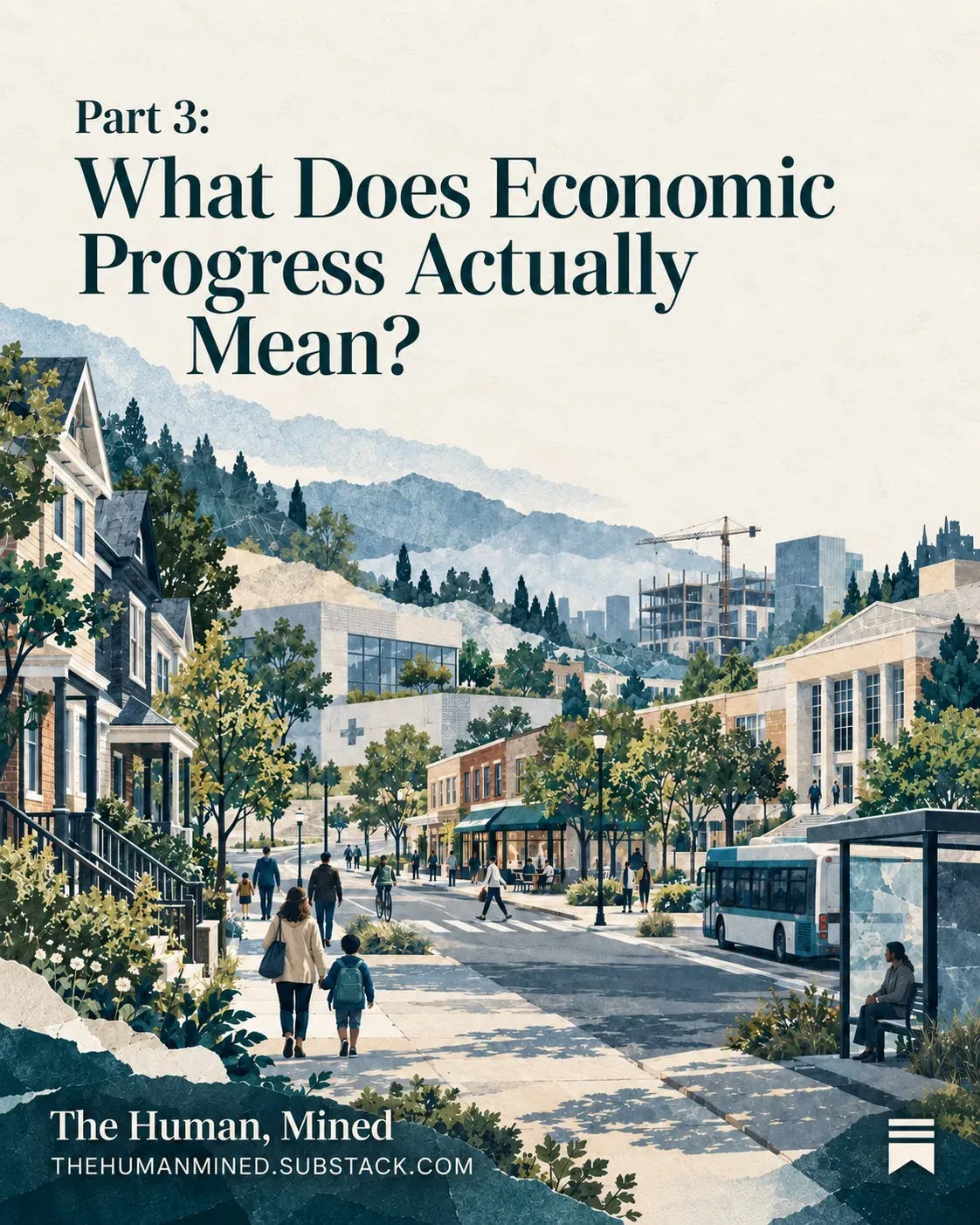
Part 3: What Does Economic Progress Actually Mean?
I’ve spent roughly thirty years working in residential construction, and during that time I’ve been involved in replacing a lot of windows.
Listen instead
19:57 · Narrated with an AI voice
I’ve spent roughly thirty years working in residential construction, and during that time I’ve been involved in replacing a lot of windows.
Sometimes the windows we’re replacing are the originals. They’re old, drafty, inefficient, difficult to operate, and clearly nearing the end of their useful lives. Replacing them absolutely makes sense.
But sometimes we find ourselves replacing replacement windows.
Someone already manufactured those windows. Someone sold them. Someone installed them. They provided real value for a period of time, but now seals have failed, hardware is worn and breaking, parts are difficult if not impossible to find, or the windows simply haven’t had a very long useful life.
So, we sell and have another set custom manufactured. Tear the old ones out. Dispose of them. Install the new ones. Ideally they will perform better and last longer. More products were produced. More money changed hands. More people were paid to do more work.
Did needing to do the job twice mean we made more economic progress?
I don’t think that’s as easy a question as it first sounds.
The inexpensive replacement windows may have been a significant improvement when they were first installed. They could have made an old house more comfortable and efficient at a price the homeowner could comfortably afford. Maybe buying substantially more expensive windows wasn’t an option. Maybe the homeowner preferred to spend the difference on something else.
So, can we simply say we should build everything to last as long as possible?
Durability costs money too.
But after spending the first two essays in this series asking what an economy is actually for and what we mean by value, that second set of windows has me wondering about something bigger.
We talk about economic progress in terms of growth all the time. More production. More spending. More jobs. More sales. And historically, economic growth has helped produce extraordinary improvements in the way people live. That is hard to argue.
But if the economy is a tool, and monetary activity isn’t necessarily the same thing as value, what exactly are we working so hard to increase?
More of what?
And maybe more importantly:
To what end?
GDP gives us one important piece of information: the market value of final goods and services produced within the economy over a specified period of time. It wasn’t designed to measure everything we value, and economists don’t generally pretend that it does.
Still, my first instinct was to lump a lot of things together anyway. More spending meant more economic activity, which meant more output, which meant more growth.
But wait.
Those aren’t all the same thing.
If someone figures out how to make a better product for half the cost, spending on that particular product could fall even while we become better at producing it. We might then spend the savings somewhere else. Greater productivity can mean getting more from the resources we already have, not simply channeling more money through the system.
So “the economy grew” tells me something important.
But what does it tell me about the progress we actually made?
I’ve run into a different version of the same question with technology.
I love learning about new technology, and when I find a product that I think could genuinely improve my quality of life, I consider buying it. To the occasional irritation of my wife, this “tech nerd” has gradually built a fairly extensive smart-home system.
It took some trial and error before I settled on an ecosystem that I felt worked well together and was easy for both of us to control. That left me with some perfectly functional hardware that no longer worked particularly well for me. I ended up giving some of it to a friend who thought he could use it.
The new equipment created value for me. My wife would begrudgingly agree that she now sees some real value in it too. The old equipment still had value for my friend.
Could I have gotten to the same place with fewer purchases if more products were designed to work better together?
Maybe.
But that doesn’t mean universal compatibility is automatically better. Different technologies develop at different speeds, from different angles, with different goals. Greater compatibility could involve tradeoffs of its own or potentially limit some other kinds of innovation.
So, I’m not sure the actual lesson is: We should buy or replace less.
What interests me is whether getting the same or better result with fewer resources would itself represent progress across the economy.
Isn’t that one aspect of becoming more productive?
It certainly seems to be for an individual product or business.
Of course, economists have been thinking about productivity for a very long time. I’m not discovering anything new by noticing that doing more with less can be valuable.
But that leaves me with the question I find much more interesting:
What outcomes are we trying to become more productive at creating?
Healthcare is where this starts to get uncomfortable for me personally.
Over the last year, I’ve dealt with some significant health issues of my own. I’ve had tests, treatments, and medications that I’m extremely grateful exist. They have made it possible to better manage a chronic condition, and I’m healthier because of them.
So, when I read that healthcare spending increased, I can’t simply treat that as bad news. Despite my frustration with rising healthcare costs, if we are curing diseases that couldn’t be cured before, restoring sight, relieving suffering, extending healthy lives, or making effective treatment available to more people, spending more can create enormous value.
I’ve personally been on the receiving end of some of that very real value.
But I’ve also looked at the cost of one of my medications and wondered why it costs what it does. I know developing certain classes of drugs can be extraordinarily expensive. Research efforts fail. Drugs have to be manufactured and distributed. Doctors, pharmacists, insurers, hospitals, and plenty of other people and institutions are involved.
Then I turn on the television and see prescription drugs advertised directly to me.
That doesn’t prove the advertising is wasteful or that the drug is overpriced. It just reminds me how many different things are buried inside the healthcare-spending number and how little that number, by itself, tells me about them individually.
What exactly am I looking at when I see the total amount we spend on healthcare?
I don’t know.
The United States spent about $5.3 trillion on healthcare in 2024, roughly 18 percent of GDP. That’s an enormous number, but the size of it doesn’t answer the question for me.
What did we get for that spending?
Even that may be too simple. Healthcare spending can buy treatment, prevention, research, diagnosis, insurance against risk, comfort, preparedness, and attempts that ultimately fail. Not all of its value can be reduced to one health outcome per dollar.
My first instinct was that prevention might give us an easy example of doing better with less. Help prevent the disease and potentially avoid the cost of treating it.
That sounded pretty obvious.
It also turns out to be too simple.
Preventive care can create substantial value without reducing total healthcare spending. Some preventive measures save money. Others cost more money but produce better health. If we spend more and people live longer, healthier lives because of it, I’m certainly not prepared to call that economic failure.
Spending more isn’t necessarily the problem. And spending less isn’t necessarily the goal. That leaves me with a thought experiment I’ve had a difficult time getting past.
Suppose someone cures an expensive chronic disease.
Not a better treatment. Not a medication that manages it for the next thirty years. Not a massive lifestyle change that requires the patient to live differently.
A cure.
Assume it works, it’s safe, and eventually becomes affordable enough to use broadly.
Think about what could start to disappear.
Years of prescriptions. Specialist appointments. Procedures. Hospitalizations. Insurance claims. Copays. Caregiving. Missed work. Patient and family stress. Financial strain.
Billions of dollars of spending associated with managing that disease could start to disappear. So could enormous amounts of labor, medical capacity, patient time, family time, and other resources that had been devoted to it. Other treatments might quickly become irrelevant, along with some of the resources that provided them.
And the people who would have required all of that care?
They’re healthier. They have some of their freedom back. That sounds like progress.
But does any of that actually mean the economy as a whole gets smaller?
Not necessarily.
The doctors don’t disappear. Neither do the researchers, facilities, money, labor, or patients. The cure itself and everything involved in getting it to patients is economic output. Doctors and hospitals have more capacity to treat other patients. Researchers can work on solutions to other problems. Healthier people may work, spend, invest, travel, or do other things their illness previously made impossible.
Those resources can go somewhere else. And that almost makes the next question more interesting.
Could one of the greatest successes of the healthcare economy be eliminating enormous amounts of healthcare spending, labor, and time that would otherwise have been required to manage a disease?
I think it could.
But then another complication shows up. The cure had to come from somewhere.
Someone had to fund the research. Scientists had to do the work. Many attempts probably failed. Investors had to accept substantial risk. Companies needed some reason to devote enormous resources to solving the problem in the first place.
So now I have two ideas that seem to be true at the same time.
It seems to me that economic progress should include becoming better at reducing the resources required to produce outcomes people value.
But the prospect of future revenue may be part of what creates the incentive to develop the innovation that makes some of that future spending no longer necessary.
I’m not sure how those fit together.
Maybe sometimes the incentives align beautifully. Solving the problem creates enormous value, and the people who provide the solution are rewarded accordingly.
Maybe sometimes they don’t.
When do private incentives line up with actually eliminating the underlying problem, and when do they reward continued transactions around it?
I don’t know.
Questions about who captures the gains or what government should or shouldn’t do about any of this get much harder very quickly. Those belong later in this series.
For now, the tension itself seems important.
How should we recognize progress when part of the value created is the future spending, effort, and time that no longer have to be devoted to the problem?
That makes me wonder what happens if I push the idea to a seemingly absurd extreme.
But is it absurd if enough time passes?
Imagine we became extraordinarily effective at providing many of the things people need and value. Food, shelter, energy, healthcare, transportation, manufactured goods.
What if we could provide comparable or better outcomes while requiring dramatically less labor, finite natural resources, energy, time, or expense?
People wouldn’t stop wanting or needing things. New technologies, experiences, services, and entirely new categories of wants would continue to emerge. Scarcity wouldn’t completely disappear.
But suppose enormous amounts of the economic activity currently required to satisfy many of today’s needs were no longer required to achieve the same or better outcomes.
Would that represent less progress because fewer resources and less economic activity were now being devoted to solving those particular problems?
Or could that be evidence of just how much progress we had actually made?
Maybe this brings me back to where I started this series.
If the economy is a vehicle rather than the destination, perhaps its success isn’t ultimately measured by how much activity the vehicle generates. Maybe it’s partly measured by how effectively it gets us where we’re trying to go and what it takes to get us there.
Greater efficiency can also return one resource to us that has so much value because we can never manufacture more of it:
Time.
Less time producing something. Less time repairing it. Less time managing an illness. Less time earning the money required to pay for the things we need and want.
That doesn’t mean everyone should work less. Someone may use that time to earn more, pursue something entirely different, or simply take it back for themselves.
The important part isn’t that I think one of those choices is better.
It’s that the time becomes available to choose again.
That’s part of the freedom I’ve been trying to understand throughout this series.
But there’s a problem with saying that greater efficiency simply “frees” all these resources.
Freed for whom?
A worker whose job disappears because of a productivity improvement may not experience the change as progress at all. The gains may go largely to someone else. And resources that become available for something new aren’t guaranteed to be used well.
History is full of this tension. As agriculture became more efficient, output grew dramatically while fewer people were required to produce it. That created the possibility for labor and other resources to be used elsewhere.
But saying that from a distance is a lot easier than being the person whose livelihood disappeared during the transition.
So maybe creating the capacity to do something else and actually making people better off aren’t always quite the same thing.
What happens to the people displaced by progress?
Who captures the benefits?
Those questions matter, but they’re bigger than this essay. I’ll have to come back to them. For now, I’m left with something narrower. We can solve a problem more efficiently and create the possibility of doing something else with the resources we no longer need to devote to it.
What happens next depends partly on what people value.
That’s where the last essay keeps interfering with this one. I don’t get to decide what they should value. And that makes me less interested in whether economic progress ultimately means more or less money moved.
More healthcare spending could mean treatments that didn’t exist before. Less healthcare spending could mean we cured something that once required decades of treatment, or it could mean people simply can no longer afford the care they need.
More purchases could mean genuinely better technology. They could also mean replacing products that failed or became obsolete sooner than we would have preferred.
Fewer hours of labor could mean extraordinary productivity gains. They could also mean people can’t find work. These numbers matter.
But their direction, by itself, doesn’t tell me whether the outcome was progress. “The economy grew” still tells us something important. I’m just no longer sure it tells me what I most want to know.
What did we get better at doing?
Maybe that’s closer to the question I’ve actually been trying to ask all along.
Did we get better at producing the things people value?
Did we need fewer resources to do it?
Did that give people more ability to pursue something else they value?
And if it did, who actually gained that ability?
I’m not sure those questions amount to a definition of economic progress. And I’m certainly not sure exactly how we would measure the answers. But simply asking whether we produced more now feels incomplete to me. It leaves perhaps the most important parts unanswered.
More of what?
To what end?
Questions to sit with
- Did needing to do the job twice mean we made more economic progress?
- So, can we simply say we should build everything to last as long as possible?
- But if the economy is a tool, and monetary activity isn’t necessarily the same thing as value, what exactly are we working so hard to increase?
There are no right answers here. Just honest ones.
Where do you land?
Steelman the other side
The best case against this essay
The essay questions whether growth in output and spending, as measured by figures like GDP, is a good guide to economic progress.
- Market spending is not just noise. It records choices people made with their own money, so it shows something about what they valued. Any alternative measure of what is 'really valuable' means someone else's judgment takes the place of those choices, and that judgment can be wrong too.
- GDP is already the result of efficiency gains. When a cure or a cheaper product frees up resources, those resources usually go into new output, so growth tends to pick up the gains the essay describes. Over long periods, growth has tracked closely with longer lives, less poverty, and more leisure.
- Broader measures of progress are hard to define and easy to manipulate. A narrow, consistent, well-understood number may be more useful in practice than a richer one that cannot be measured reliably or compared across countries and decades.
- Concern about who captures the gains is real, but slow growth usually makes displacement and inequality worse. Growing economies give displaced workers more new jobs and give societies more resources to help people through transitions.
Know someone who'd argue with this? Send it to them.